
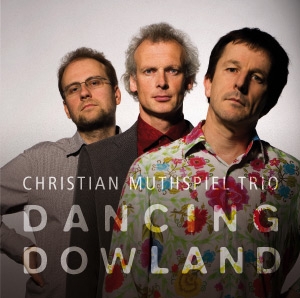
Dancing Dowland
Christian Muthspiel Trio
music on “Lachrimae, or Seaven Teares” by John Dowland
Christian Muthspiel – trombone, piano
Franck Tortiller – vibraphone
Georg Breinschmid – bass
2009 Emarcy/Universal Music Nr. 0602517999947
Liner Notes
DANCING TEARES – 10 Versuche über John Dowland
Als Sohn eines Musikers, der sich schon ab den 1950er-Jahren intensiv mit Alter Musik beschäftigt hat, gehörte die Musik der Renaissance zum Soundtrack meiner Kindheit. Die wie endlos wirkenden, schwerelos schwebenden, von Taktstrichen unbehelligten Linien der polyphonen Stimmengeflechte eines Tallis, Ockeghem, Schütz, Allegri oder eben Dowland üben bis heute größte Faszination auf mich aus.
Knapp vierhundert Jahre liegen zwischen John Dowlands Geburt und der Mitte des 20. Jahrhunderts, in welcher der Jazz seine wohl vitalste und revolutionärste Ära erlebte. Beschreibt man einige der wichtigsten Merkmale der Musik der Renaissance und des Jazz, tritt eine Reihe von Parallelen zutage: Die oftmals freie Wahl der Instrumente; die Skizzierung eines harmonischen Verlaufes, dessen Ausformung durch Improvisation mit musikalischem Sinn erfüllt werden muss; der daraus resultierende Freiraum für den Interpreten, welcher dem Werk die entscheidenden Impulse erst im Moment der Aufführung verleiht; die Möglichkeit, Stimmen hinzuzufügen oder wegzulassen u.s.w.
Je weiter man in der Geschichte der notierten Musik in die Vergangenheit zurückblickt, desto rudimentärer, skizzen- und rätselhafter erscheint uns das Notenbild. In Partituren der Renaissance gibt es zumeist weder Angaben bezüglich Tempo und Dynamik, noch Vorschriften zu Phrasierung und Artikulation. Das Schöne daran ist das daraus entstehende Rätsel, welches unsere Vorstellung fordert und fördert, das Geheimnis, wie diese Musik in ihrer Zeit geklungen haben mag. Ein Song von Dowland (1563-1626) dürfte von unterschiedlichen Musikern seiner Zeit genauso verschiedenartig interpretiert worden sein, wie etwa ein Jazzstandard mit jeder Band, die ihn spielt, eine ganz andere und oftmals neue Gestalt annimmt. Das, was zwischen den Zeilen steht, wird zum Wesentlichen. Das alte Material bleibt formbar, kann zur eigenen Musik umgedeutet werden, ohne gänzlich verbogen werden zu müssen. Mit Werken der Klassik und Romantik zum Beispiel verhält es sich aufgrund der immer genauer definierten Vorlage ganz anders.
Alle Kompositionen dieser Einspielung sind aus Dowlands meisterhaftem Instrumentalzyklus „Lachrimae, or Seaven Teares” extrahiert. Sieben verschiedene Arten von Tränen werden hier von fünf Gamben und Laute vielstimmig besungen. Meine „Metamorphosen” bleiben dabei sehr nahe am thematischen Material des Originals, um die sehr spezifische Linienführung und daraus resultierende Harmonik als grundlegende gestalterische Elemente weiter zu verwenden, umzudeuten, in andere Kontexte zu stellen. Aus Dowland´schen „Keimzellen” neue Stücke im Spannungsfeld zwischen Kammermusik und Jazz zu komponieren, die vor allem auch als Sprungbretter für unsere Trio-Interaktionen dienen, war das Ziel. Denn jede Jazzkomposition muss auch den improvisatorisch zu erfüllenden Raum definieren. Besonderes Augenmerk kommt dabei den Tonartenverwandtschaften zu, welche mit den im „Lachrimae”-Zyklus zentralen Skalen von A-Moll, A-Dur, C-Dur und E-Dur meist um Terzverwandtschaften kreisen. Daher könnte man auch die zehn Triokompositionen in annähernd jeder beliebigen Reihenfolge spielen, ohne die harmonischen Bezüge der
Stücke zueinander zu schwächen.
Dass die Umsetzung eines solchen Vorhabens nur mit Musikern gelingen kann, die sich in der Welt der komponierten Musik genauso selbstverständlich bewegen wie als Improvisatoren und Jazzmusiker, ist evident. Die Spielweise und der Sound meiner beiden großartigen Mitmusiker waren daher Voraussetzung für mich, dieses Projekt zu wagen und uns, einem seit einigen Jahren in gleicher Besetzung spielenden Trio, „Dancing Dowland” auf den Leib zu schneidern.
Christian Muthspiel, Jänner 2009
english
DANCING TEARES – 10 Attempts at John Dowland
As the son of a musician who was working intensively with Early Music already in the 1950s, I grew up with Renaissance music as the soundtrack for my childhood. To this day, I am fascinated by the polyphonic interweaving of voices that seemingly float on forever, unimpeded by bar lines, of composers such as Tallis, Ockeghem, Schütz, Allegri , and of course Dowland.
Nearly 400 years elapsed between the birth of John Dowland and the mid-twentieth century, which was the peak revolutionary era of jazz. Yet when you compare the dominant features of Renaissance music and jazz, numerous parallels stand out. Among these are the relatively free choice of instruments; harmonic structures indicated in broad outlines, to be developed or filled in with appropriate musical improvisation, allowing performing musicians to provide their own interpretations and follow their inspirations of the moment; and the option to add or subtract voices at will.
The further you delve back into the history of notated music, the more sketchy, rudimentary and enigmatic the notation seems. In the music of the Renaissance you rarely find indications of tempo, dynamics, phrasing or articulation. The beauty of this is that our imaginations are fired as we are challenged to work out how these works might have sounded in former times. A song by Dowland (1563 -1626) must have been interpreted by the musicians of his day in as many ways as jazz standards are played by today’s bands, who often give them a new form and feel. Here, emphasis is placed on what lies between the lines; the old material remains malleable and can give space for new music without totally losing its shape. The scores of classical and romantic music, for example, were defined much more precisely.
All of the compositions in this recording are based on Dowland’s masterful instrumental cycle Lachrimae, or Seaven Teares, in which seven different types of tears are captured polyphonically by five violas da gamba and a lute. My metamorphoses stay very close to the thematic content of the originals in order to use the specific lines and resulting harmonies as fundamental structural elements to be taken up again and given new meaning in other contexts. The goal was to use this seed material from Dowland for composing new pieces in the high-tension field between chamber music and jazz, to serve as a framework for interaction within our trio, because every jazz composition must also define the spaces to be filled with improvisation. A distinctive feature here is the use of the original keys found in the Lachrimae cycle, which revolve around the central scales of A minor and A, C and E major, mostly in progressions of thirds. It is therefore possible to change the order in which the ten trio compositions are played without effecting the harmonious relationship of the pieces one to the other.
Obviously, for such an endeavour to work, you need musicians who feel equally at home in the world of composed music as they do with improvisation and jazz. This was a prerequisite for me and it’s only because of the tremendous sound and musicianship of my two great playing partners of the last few years that I dared to undertake this project and write Dancing Dowland especially for our trio.
Christian Muthspiel, January 2009
translation by Karin Kaminker
Preise in Euro (€) / Prices in Euro (€):
Preise inkl. 20% Mwst. zuzüglich Versandkosten / Prices incl. 20% VAT plus shipping costs.
Verkaufs- und Lieferbedingungen / conditions of sale and delivery:
Versandkosten / shipping costs: Austria € 3.-, Europe € 5.-, rest of the world € 10.-
Ab einer Bestellung von 3 CDs wird innerhalb Europas kein Porto verrechnet.
For an order of 3 or more CDs we do not charge shipping costs within Europe.
Bestellte CDs werden mit Rechnung an angegebene Rechnungsadresse gesendet.
Ordered CDs will be sent to billing address with receipt.
Für weitere Informationen und Fragen senden Sie bitte ein Mail an: CD-shop
For further informations and questions please send mail to: CD-shop